

The Art of Cold Messaging: How to Write a LinkedIn DM or Cold Email That Actually Gets a Response
Whether you’re asking for a coffee chat, reaching out for a job referral, or genuinely want to connect with a professional you admire, this one’s for you.
Let’s talk about the art of cold messaging.
I get around ~100 of these a month. Some are so long and vague that I have no idea what they’re asking, and some I still think about because they made it super easy for me to help them. Ones written from the heart, with genuine curiosity, and that don’t make me feel like they’re using my brain as their personal search engine.
As someone who’s been on both sides of the inbox (yes, even still to this day), the art of a good cold message comes down to three things, and today we’re breaking it down
First things first: Keep it short and sweet
You’re reaching out to a stranger (or someone you’ve briefly spoken with), they do not need an essay on your life, your career thus far, and all of the reasons you’re reaching out to them. Most people read their DMs/emails on their phones and skim messages, too; the longer it is, the more likely they are to leave you on read.
Your goal is to capture their attention and get a response.
As a good rule of thumb, I like to keep my cold messages down to 1-2 paragraphs (usually 6-8 sentences) that cover the following:
Who you are: A quick introduction. One or two sentences, max.
Why you're reaching out: What made you choose this person?
What you want: The actual question, request, or opportunity you're reaching out about.
How they can respond: A clear, reasonable next step (a call, option to respond when they can, etc)
Here’s a message I sent recently to someone for a speaker opportunity I applied for.
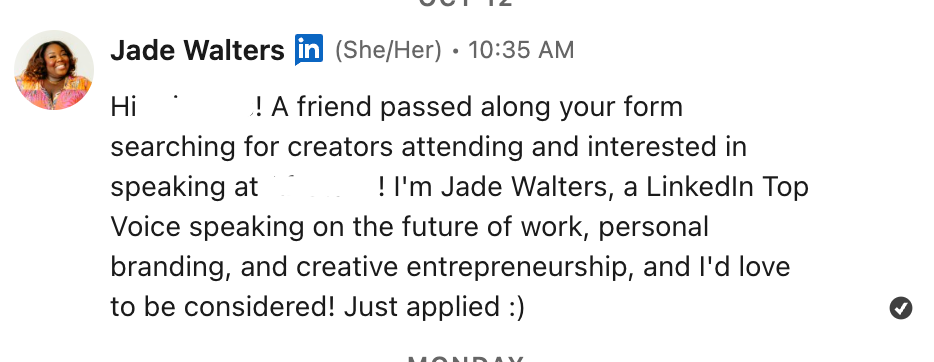
This was in the form of a LinkedIn connection note, which is max ~300 characters for Linkedin Premium, a very limiting amount of characters. I was personable, straight to the point, and we connected in less than 48 hours.
Make it easy for people to know what you want so they can know if they want to help you.
If they have additional questions, they’ll ask. Don’t overwhelm them with information
Now, who should you message and how to find them?
LinkedIn is a powerful tool when used correctly. I don’t believe in using tools like hunter.io and apollo.io to email people you’ve never met - it’s weird and often not done correctly. I think LinkedIn is a nice middle ground, especially if it’s someone you’ve been following for a while and finally got the courage to reach out.
Trust me, reaching out to strangers can be nerve-racking, but remember: the worst someone can say is no! You miss 100% of the shots you don’t take, and the more DMs you send, the better you’ll get at shooting your shot online and in person.
Here’s a good list of where you can start when reaching out
Start with people you already know
Look through your existing network. That old co-worker? The classmate who was pretty cool? You’d be surprised at how cool your current network is and how much has changed since you last spoke. You’re more likely to hear back from them too since you’re already connected
LinkedIn’s gotten pretty good at telling you who in your network works at a company you’re interested in or has mutual connections with people in the field/industry/organization. Sixth degrees of separation is real.
Use LinkedIn’s People Tab
If I don’t know someone at an organization, I go on the company’s page > go to the People tab > see who works there and if we have mutual connections. You can even ask a mutual connection to connect you.
Another pro tip? Check their activity. Not everyone is as active as you on LinkedIn. Check their page and go to the comments or likes section to see if they’ve interacted with anything in the last week. That’ll tell you whether or not they’re active, aka if they’re on LinkedIn enough to see your cold DM
Looking for a job referral?
One trick I've shared before is searching "[Company Name] employee referrals" on LinkedIn and filtering the results by posts.
Sometimes employees will publicly share that they're open to referring people to opportunities at their company.
I used to do this when I worked at TikTok, so I know there are people out there who genuinely want to help candidates get their foot in the door.
But remember: just because someone works at a company doesn't mean they owe you a referral.
Some people are comfortable referring to strangers. Others aren't, and that's completely fair.
Read their posts, follow their instructions, and don't take it personally if someone isn't comfortable referring to you.
Also, before you start sending messages, make sure your LinkedIn profile is up to date. If someone is curious about who you are, that's probably the first place they'll look.
Okay, now let’s get into why you’re really here: WHAT do you say in your cold message?
I’m not a fan of copy-and-paste message templates. They don’t leave room for my favorite parts of a good message: passion and personality. Templates aren’t bad but sometimes people just copy them word for word, change the name, and send the same message to everyone.
And just to let you know, people can tell. So here’s how to structure a good message that sounds like you. Here’s my framework:
Introduce yourself → Make the connection → Get to the point → Close with a clear ask.
And this can change depending on the task.
Coffee Chat Requests
Stop asking people to “pick their brains” or making vague requests to talk for 15 minutes. If you're asking for their time, be intentional about what you want to discuss. Your message should be thoughtful and give context to the topic(s) you want to discuss, and why you're reaching out.
It’ll also give them a chance to decide whether or not they want to talk to you. Some questions can be answered easily in a LinkedIn message; others are worth a 15-minute call.
Give them the option to choose by giving them enough context in your initial message. Don’t take it personally if they don’t want a call
Job Referrals/Job Application Interview
This one’s a little controversial. Not everyone is open to giving referrals to strangers and not every recruiter has the bandwidth to respond to the “I just applied, I'd love to be considered for an interview” message. Honestly, there are legal reasons why they can’t do this (but that’s another conversation for another day)
You don’t need to send your resume and portfolio (unless they ask). Tell them what role you're interested in, include the job ID if there is one, and briefly explain why your experience aligns with the opportunity.
And PLEASE, make sure you’re reaching out to someone who actually works at the company. You’d be surprised how often I’ve been mistaken for a recruiter at Google, Adobe, Capital One, and many other companies.
Take a second to verify where someone works by looking at their LinkedIn and then send your message.
And if you’re trying to build your network
You don't always need to ask for something immediately. No one wants to feel used for a connection.
Maybe you saw one of their posts that resonated with you, attended the same event, or are genuinely interested in their career; start there and reach out. Just make sure your message has a reason behind it.
Networking doesn’t have to be transactional. You can use cold messaging to genuinely connect with someone and build a relationship!
Let's look at an example for reaching out about a role.
Say you're interested in an open position and you've found someone on LinkedIn who works on the team.
Here's how I'd think about putting that message together:
The connection: Introduce yourself and mention the specific role you're interested in.
The context: Briefly highlight relevant experience that makes you a potential fit.
The ask: Ask whether they're open to sharing insight into the position or pointing you toward the appropriate contact.
For example:
"Hi Kayla! I'm a recent graduate with experience supporting campus recruiting and employer branding campaigns, and I came across the Recruitment Marketing Coordinator opening on your team (Job ID: 12345).
I noticed the role focuses on early-career talent campaigns, which aligns closely with the work I've been doing at [insert company, quick line on the work]. I'd love to learn more about the opportunity and was wondering if you'd be open to sharing any insight into the role or directing me to the appropriate recruiter. Thanks so much!"
Notice that the message isn't trying to tell Kayla everything about the sender.
It tells them who the person is, what they're interested in, why they're reaching out, and how they could help.
Use that structure as a starting point. Your experience and reason for reaching out should be specific to you.
And finally, the art of the follow up
Say you’ve done all of this outreach and you haven’t heard back.
Don’t take this as an invitation to find their email, Instagram, and phone number to get them to pay attention to you. This isn’t a sign of being “proactive” and a go-getter. It can actually creep them out and get you blocked.
My rule of thumb: You get TWO follow ups from me. THAT’S IT!
After that, I’m leaving you alone. There can be so many reasons why someone hasn’t replied:
They missed your message
They’re busy dealing with their own personal or professional problems,
You caught that at a bad time
or…. they're just not interested
I recently reconnected with a CEO I've admired for a while, and they told me I was amazing at following up.
And that stuck with me because following up can show someone you're serious about making a connection or pursuing an opportunity. Sometimes someone isn’t ignoring you, they just need another little nudge. But there's a difference between being intentional and being overbearing.
Timing matters.
How quickly you follow up depends on what you're asking for.
If you're reaching out about something time-sensitive, like an application deadline or interview feedback, a follow-up within 48–72 hours might make sense.
If you're asking someone for a coffee chat or career advice, give them a little more grace. You’re asking them for a moment of their time.
Keep your follow-up short.
A simple reminder of your original message, a quick restatement of your ask, and a polite close are enough.
In conclusion, cold messaging is a vulnerable act.
You’re reaching out to someone you don’t know/barely know and hoping for a reply. You miss 100% of the shots you don’t take and honestly, sometimes the ones you miss can teach you a lot!
Do your research. Keep it short. Get to the point. Make your task clear. And don't be afraid to follow up when it makes sense.
Not everyone will respond, and that's okay.
What matters is that you're learning to advocate for yourself, put yourself out there, and see what can happen when you’re not afraid to hit send. Each step will get you closer and closer into rooms you want (and deserve) to be in.
